Why Your AI Agent is Lying to You (and How to Fix It)
Your support agent issued a refund policy that does not exist. Your research agent cited a study nobody published. Your coding agent swore the tests pass — they do not. It feels like deception, and teams respond to it like deception: they lose trust, rip the agent out, and swear off automation for a quarter. That reaction wastes the diagnosis.
Hallucination is an execution problem
Agents do not lie; they complete. When the execution layer underneath the model is untested — stale retrieval, vague tool contracts, no verification step — the model completes patterns instead of facts. The output reads confident because confidence is a property of the grammar, not of the evidence. Treating this as a personality flaw leads you to swap models. Treating it as an engineering defect leads you to fix the pipeline.
The three failure modes
- —Confident fabrication — invented facts, citations, or policies. Root cause: no grounding check against a source of truth.
- —Silent drift — the agent slowly stops following its instructions as prompts, tools, or data change. Root cause: no regression evals on real tasks.
- —Tool misuse — the agent calls the right API with wrong arguments, or the wrong API entirely. Root cause: untyped, untested tool contracts.
An agent that can't be graded can't be trusted.
Diagnostics before discipline
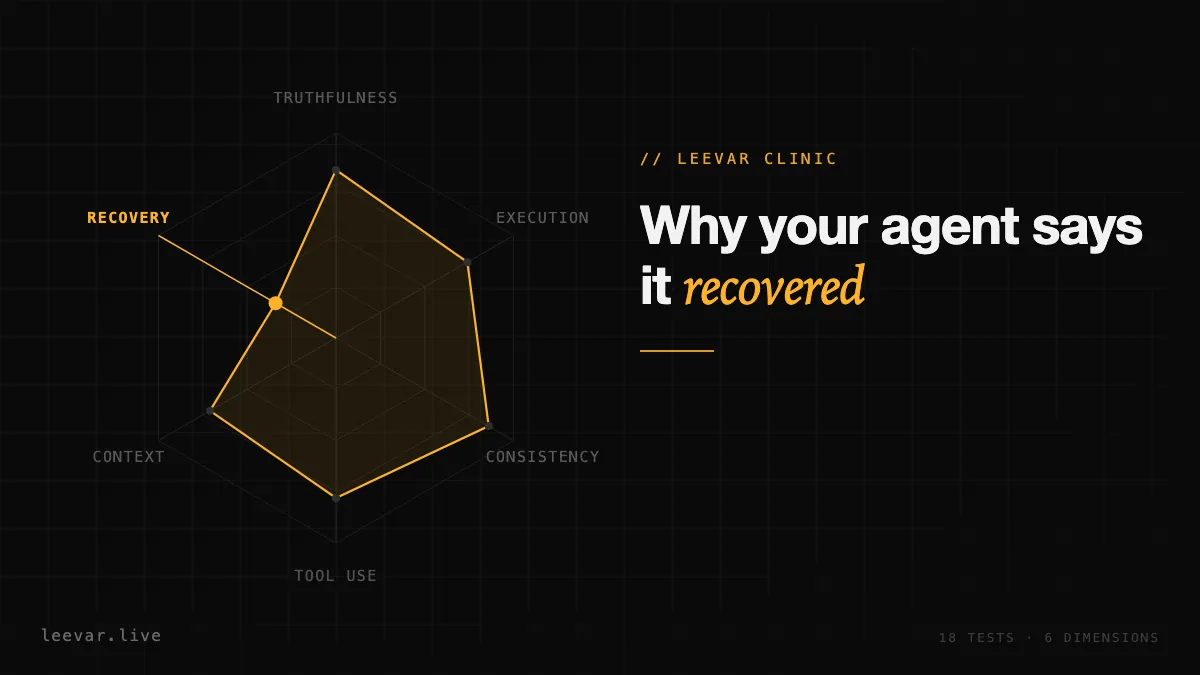
You cannot fix what you have not measured. Before changing a single prompt, run the agent against a battery of known-answer tasks drawn from your real workload and grade it: task completion, factual accuracy, tool correctness, instruction retention. This is exactly what the Leevar Clinic does — a diagnostic scan that ends in a letter grade and a failure map.
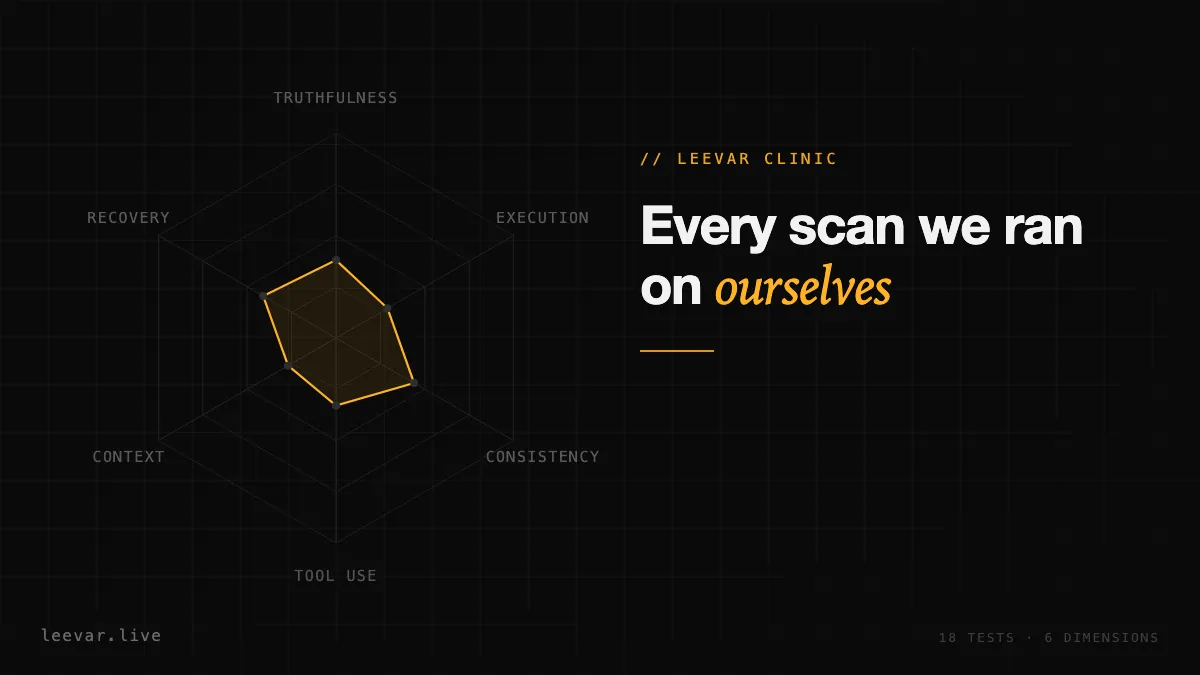
A customer’s report is theirs, so the reports we publish are our own — F grades included, and one grade our own gate refused to give us: every scan we have run on our own agents.
The QA gate pattern
The durable fix is structural: put an independent verification step between the agent and your customers. Ground every factual claim in retrieval, type every tool contract, and re-run evals on every change — the same discipline you apply to code, applied to behavior. On Leevar, an order is checked against acceptance criteria the client approved before it reaches them; no client order has run that pipeline yet.
Fabrication is one of six axes an agent breaks on, and it is rarely the only one firing at once — why agents fail in production is the map of the other five, and the truthfulness dimension is how this one gets measured.
Your agent is not lying to you. It is showing you the exact shape of the tests you have not written yet.
Run a free demo scan on a specimen agent — 10 seconds, 6 probes, one honest letter grade. The real scan is free too: five a month.